Wednesday, August 16, 2017

IT'S TIME TO MOVE TO GREENER PASTURES...

Or, well, a more popular blogging site anyways...

Margins & Muses has moved to WordPress!


Once upon a time, when M&M was just a wee blog baby looking for a home, I ventured to WordPress and was a bit overwhelmed by all the options for customization. Blogspot seemed much more user-friendly (and by user-friendly I really mean easier to navigate for a noob like myself), so that was where I decided M&M would set up shop. But now, WordPress seems the best option for all my blogging needs, so we're moving house!

I hope you'll migrate with me as I export and import my way to those greener blogging pastures!

xoxo,


CM

Tuesday, August 15, 2017

#FreetheBoobies


So this is definitely not my normal writing-related post. And, ladies, this one's for you (and maybe you too, open-minded guy). I'm going to try my best not to turn this into a feminist rant (if you know me, you know that I'm a HUGE fan of feminist rants so this may be difficult). 

Okay. So. Can I make a suggestion? Once a week, ladies, spend a full day without a bra on. No matter where you're going. At home or out and about. Just once a week (or twice a week if you're feeling brave!).


And can we, like, collectively as womankind really throw this movement into full swing (see what I did there)? I've been a fan of #freethenipple since day one. But outside of Instagram, Twitter, and the internet in general, I don't see many free nipples out there in the wild, thriving in their natural habitat. How come?

We are under no contractual obligation to hide our nipples. To, every day, strap ourselves into these contraptions that itch and rub and dig and gore us with broken wires and cost a pretty penny.

I don't want to feel like I have to put on a bra just to go grocery shopping--or out to eat. Or, dare I say it? TO WORK--on the off chance that my delicate-less delicates make someone feel uncomfortable. I put on deodorant for that reason. That's me doing my part for humanity.

And let us not forget that, even if you DO don a bra, you will get looks if that bra, like your nips, is SHOWING. Even a white bra will be a pair of glowing white triangles under a white shirt. I don't want to even think about how many times someone has disdainfully said to me, "Do you know your bra is showing?" SO WHAT? Even if I said EFF the bra, I'd get those same sideways looks of disapproval if my lady pointers decided to put themselves on parade. How does that make sense? The answer is: it doesn't.

Watch this. It's fabulous. 
Now, don't get me wrong. My girls appreciate some support every now and then. Particularly on hot days when the boob sweat is positively oceanic. Or when I'd like them to be a bit perkier, with a bit more "pick me up," a bit more Victoria and a little less Nana, for a night out. I wear TWO sports bras when I work out.

So wear a bra when you want to. Likewise, don't wear one when you don't want to. I'm only asking that you make the choice based only on your feelings. Not societal expectations or worries about what OTHER people will think. It's helped me feel more comfortable in my skin, to be more accepting of my body and the way things fall where they may. It's been liberating. And we all deserve to feel liberated. So, #freetheboobies.

Also this video. In which a few women don't go to boob jail for a week. 

~Be mindful of the constraints of society. They can be both emotional and physical.~


Thursday, June 8, 2017

Question Your Inner Reader to be a Better Writer


It's easy to forget sometimes that writers should ALWAYS be voracious readers. Reading makes us better writers. Read everything, including books outside of your genre-bubble. Consume everything. Buy/Borrow every book. THEN EAT THE BOOK AND DIGEST ITS SOUL!


.....*ahem*

Looking at yourself as a reader can help you to better understand who you can be as a writer. Asking your inner reader questions can be a great way to teach yourself to be a superior storyteller. 

Here are some questions to get you started:


1. Why do I read?

2. What do the books I love have in common?

3. Who am I as a reader? What do I want out of a story?

4. If you could write like one author, who would you choose? Why?

5. What is one beginning AND ending (can be from different books) that has stuck out to you as a reader? What made them memorable for you?

6. What characters/fandom would you get in a duel over to defend their honor? Why?

I think you can see where I'm going with these questions. Look at your favorites, then look at why they're your favorites. Ask yourself how you can emulate those characteristics in your own writing. Interview yourself! Then be inspired by the stories you love and WRITE LIKE THE WIND, FRIENDS!


Tuesday, May 9, 2017

FEAST YOUR EYES ON THIS: My Author Website Reveal


So, I gave an author website a shot a couple months ago! Figure if I lay all my ducks in a row, one of them will quack eventually!

Wix was super easy to use, I can't recommend it enough! And I'm really pleased with what my amateur self was able to put together! Feel free to have a browse, call me out on any typos, or gawk at my growing number of WIPs! So many novel ideas, so little cushion left in my buttocks for writing them >_< 

Now that I think about it, does the writing community suffer from a flat-butt epidemic?? Or are standing desks something people actually invest in?? Treadmill desks? Pool desks? LIE DOWN DESKS!?! *checks Amazon just to be sure*


Writer's Cookbook: Recipe for a Love Story


A heaping spoonful of lust, two ripe and heaving bosoms, a pinch of drama, and a generous portion of bristling testosterone and you’ve got a love story ready for consuming. Right?
In the world of Harlequin romance novels, maybe. But many writers struggle with the recipe for writing true love, for a story about romantic love on a more complex and profound level. And while the writer may struggle, the readership DEFINITELY doesn't. Romance fiction generated $1.438 billion in sales in 2012 and was the top-performing category on the bestseller lists the same year.
Your readership exists. In huge numbers. And most crave something more than the "wham, bam, thank you ma’am" realities of modern society. Can you imagine how Jane Austen or Charlotte Bronte would feel if she found out that courtship has been reduced to swiping left or right on a phone app? Blasphemy! 
So how do you produce a good love story that will quell the hunger of millions of romantic fiction (romfic) fans? It's simple, really! So simple I'll set it up like a recipe. So simple you need only incorporate four simple ingredients!
That’s it. Four ingredients (and some culinary know-how), which should all be added in equal parts: strong characters, passion, obstacles, and growth – although change makes a good substitute.

1. Strong Characters

This is vital for all fiction, but especially so for romfic. This is because the reader must fall in love with one of your main characters. Would Mr Darcy have set readers’ hearts aflame if he were a silly cad with no redeeming qualities? Absolutely not. He was a judicious gentleman of impressive intelligence and refinement who secreted away a tender heart. You want Elizabeth and Darcy to end up together because that means you get to end up with him as well, and a character must be dynamic and three-dimensional, otherwise who will fall in love with them? Your characters need to have traits that compete against each other. They must realize and struggle against their worst qualities for the sake of love.

2. Passion

Once you have strong characters, stick them together with a generous dollop of passion. If characters are really in love, a sense of passion should also be provoked within the reader – they need to feel the depth of your characters’ emotions for one another. Passion measures this depth and is the rubber band that you tie around them. No matter how hard they pull and stretch apart, that passion will bring them back together in the end.
Passion also means that your characters must fall for each other, hard. They can play around with the idea and question their true feelings, but the reader must know that, when push comes to shove, their love is unquestionably genuine.
Dialogue is essential in communicating this. Professions of love are acts of passion. A character is exposing their vulnerability during these moments of confession, articulating their deepest feelings. ‘Hey, I love you,’ just doesn’t cut it. They need to reach down deep and lay their beating heart on the table.

3. Obstacles.

Now that you’ve tied the passion band around your characters, toss in a liberal amount of obstacles to test its elasticity and your characters’ resolve. This can be in the form of an antagonist – in love stories, sometimes the best antagonists are the couple themselves – or a circumstance which makes being together impossible.
An effective obstacle is separation. They say absence makes the heart grow fonder, but your love-struck protagonists don't know that. Our star-crossed lovers must attempt to live without each other and then come to realize that, no matter ho hard things are while together, it's impossible to stay apart (think Tristan & Isolde, Romeo & Juliet, Pride & Prejudice, even Twilight for goodness sake). During this separation, the obstacles are the characters themselves. They think that, by being apart, because they're angry at each other or because they feel it's "for the best," they can dismiss their feelings. But never underestimate the power of that rubber ban of passion. 

4. Character Growth

These obstacles should come after growth and a sort of enlightenment from your main characters, which means they can overcome them. They should be able to recognize their negative traits, their differences and their flaws, and only then can they overcome the hurdles. Your characters need to grow and conquer their own negative qualities because of their love for each other. True love should inspire your characters to be the best they can be.


Now that you understand the ingredients, mix them together, follow the preparation steps (write the novel), and pop your love story in the oven. But remove just after marriage! The ending of a love story is extremely important. It needs to be optimistic and emotionally satisfying. Few readers want to read about life after marriage – it’s full of realistic issues we’re all too familiar with, problems that not even the greatest of romfic’s couples can avoid. Readers need to believe that the couple who have fought so hard to be together will live happily ever after. They’re finally happy, and that’s enough for us.
These are the basic ingredients of a love story. They’re a great start, but you’ll also need a dish to bake it in (the plot), some added spices (climaxes), a garnish or two (themes), and some nice china to serve it on (the setting). But if you’ve mixed in those four essential elements, the product will be a well-balanced meal of reading delights. Once finished, the yield will serve millions of women (and a number of curious men) who seek to experience true love through romantic fiction. As long as you have those four simple ingredients you can create the love story that mass-market publishers are looking for. You are the chef, the publishers are the restaurants, your readers the eager foodies, and your love story is the pièce de résistance.


Monday, January 30, 2017

BACK TO BASICS: Pre-Writing: Road Tripping vs Train-Tracking


WARNING: Long post is long.

Every author's writing process involves (or should involve... if not, how's that working out for ya?) these four basic steps: pre-writing, drafting, revising, and editing. There are a variety of different ways to work through each of those steps and a number of other steps that go with them.
And while there's plenty of advice out there concerning the matter and what you should do, it's SUCH a subjective process--no one can tell you HOW to do it. And believe me, everyone tries. And there's this horrible misconception that if it works for THEM it HAS to work for you too. Nuh uh. No, sir. Don't buy into that.

Writing is an intimate process and you should develop your own way of getting from idea to the end. Which isn't to say you couldn't use someone else's process/routine as an example. But don't go getting addicted to laudanum just cause Dickens did. And because I don't want to be one of those people that tell you how you're SUPPOSED to do it, I'll just tell you what works for me/how I roll. And I'll tell you now--I like to wing it.

For most, the next big step after THE BIG IDEA (and the research that entails) is to create an...ugh...outline. I am not a fan of detailed outlines. THERE! I SAID IT! OUTLINES SUCK!

For me, outlines are like getting on a train. The train can only go where the tracks lead. There is no diversion, there are no spontaneous side trips, and while the views might be beautiful, you have to stay INSIDE the train at all times.
Likewise, if you follow an outline when you write, I think you miss out on some of the spontaneity that can come from just letting the words flow. Often, writers don't know their characters as well as they'd like until they've spent a good amount of time with them/writing them. And as they write, these characters should grow and make their own choices and throw a massive stick in the spokes of your outline wheel.

I think it's best to plan as little as possible, to leave room for the characters and the story to adapt to each other and start to take their own path. But, because people (professors, classmates, how-to books) kept telling me that I HAD/NEEDED to do an outline, I gave it a shot. Once.

In the beginning it felt good to have all the tracks laid out before me. All I had to do was set my locomotive on its way. But then came this humongous pressure to stick to those tracks from chapter to chapter. And then the writing became tedious and forced. But after writing such a detailed plan, it felt like if I strayed from the outline the story would implode on itself. I've never felt so creatively stifled in my life! Needless to say, I've not tried again since.

So here's an analogy for you: outlining is to "train tracking" as winging it is to ________.


You guess it? ROAADD TRIPPINNGG!

I love road trips. You have a general direction, a decided destination, but how you get there is completely up to you.


You want to stop and see the Nation's Largest Ball of Yarn? DO IT. You want to stop at that natural hot spring and go for a swim... NAKED? Oh, my. Scandalous. DO IT.

Oh? You thought you were getting away without a gratuitous Shia gif? Think again! 
There's a wonderful freedom to road tripping. Don't get me wrong, I still have a list for the big moments that need to happen in different acts of the novel (the best attractions to stop at on my road trip), but how I get to them is completely up to that creative flow. (Sick of the transportation metaphor yet? Hang in there!)

Like I said, and will say again, ignore everything you've read when it comes to developing your own process: all the how-to books, the many different processes of the already-famous, maybe even MY advice, and do what works for YOU! Especially for your routine. Feel out different things: cafe or library, music or silence, sitting at a desk or laying in bed, in the morning or at night, outline or no outline, train tracks or the open road (had to throw it in there one more time for good measure, #sorrynotsorry).

Do you, boo boo. Do you.


~Be mindful of the influence and opinions of others, stay true to yourself.~


Thursday, December 8, 2016

How to Write Rounded Characters (and Avoid the Disney Princess Paradigm)

Creating new characters is like giving birth. Minus the nine months of pregnancy, morning sickness, and the whole "push a human out of your lady tunnel" part. And, just as if they were your own children, it's normal to want your mind babies to be perfect and unflawed.

But, in novels, character with flaws are often the most compelling.

Early Disney princesses come to mind as being the opposite of compelling. They are totally flat. Flatter than a piece of cardboard that's been trampled by a herd of elephants.

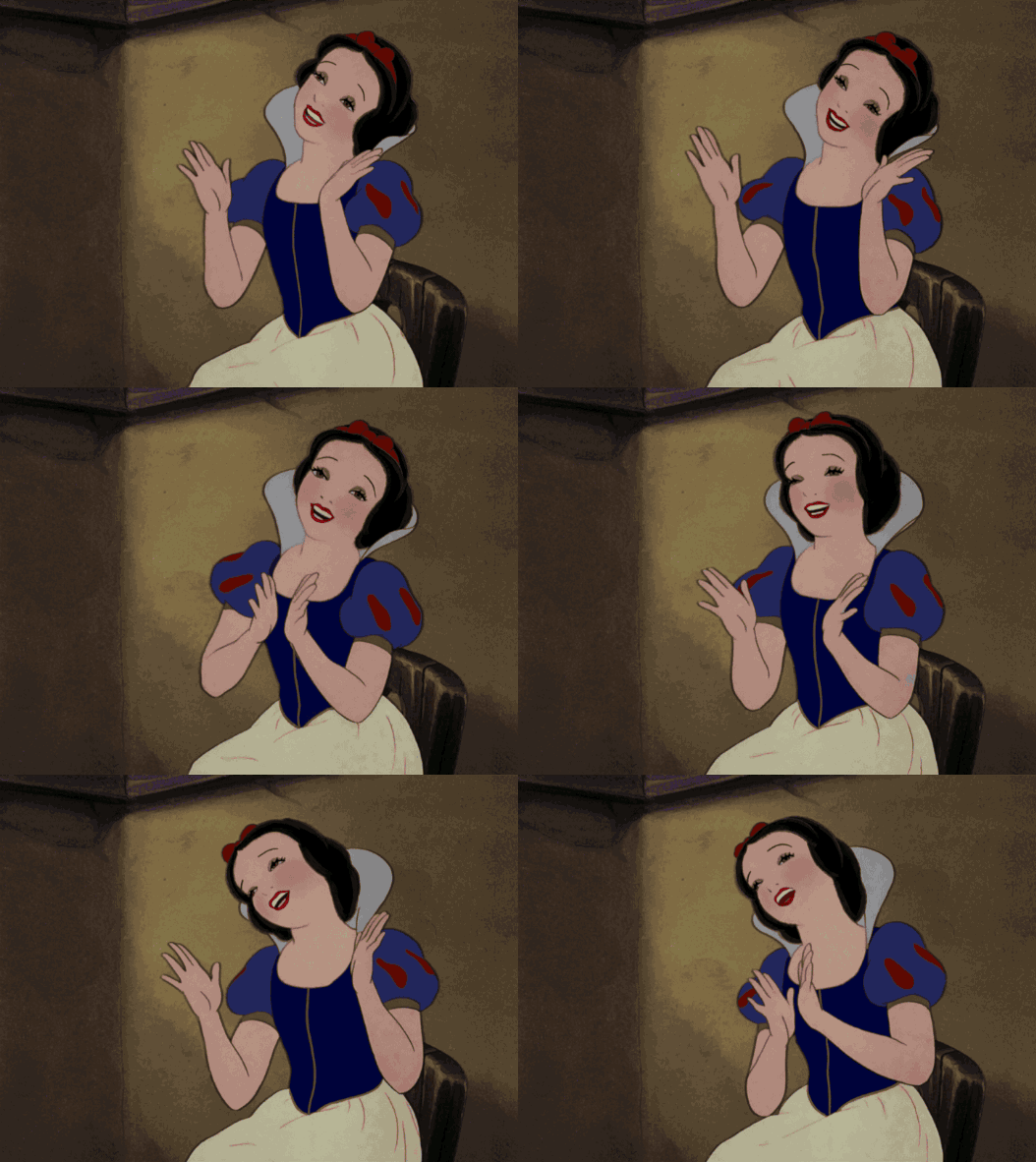
Cinderella is perfect: perfectly kind and perfectly hardworking. Princess Aurora is perfect: perfectly sweet and perfectly elegant. Snow White is perfect: perfectly innocent and perfectly pure. You seeing the trend? I call it the "Disney Princess Paradigm." Stop clapping, Snow White, it's not a compliment!

Those are a lot of good and admirable traits, don't get me wrong. But that's the problem: they're too good. They're too perfect.

And the problem with being perfect is that there's very little room for growth. What did any of those princesses learn from their stories? Can you think of a single thing? Anything?... Bueller?... Bueller?


Nothing, right!?

Real people are flawed with insecurities, fears, jealousies, etc. For every trait at one end of the spectrum, there should be a number at the other. And it's these negative traits that necessitate character growth, that force a person to confront their flaws and overcome them. And sometimes it's these traits that a reader can connect with. There's something powerful in being able to relate, to see your own mistakes and reactions and flaws in someone else. So you *puts bossy pants on* HAVE to create engaging, well-rounded characters.

To ensure my characters have positive traits AND negative traits/flaws and to keep them unpredictable and layered, I came up with a method I call the "U-List Method."

I do this for each of my characters before I start writing (though it might change as the story is written and as characters fall more solidly into place). Here's what it looks like:


Take your characters (main and minor) and apply this method to them. Draw a U, or a horseshoe if you're feeling fancy, and make a list along the "U," positive traits on the left, neutral at the bottom, and negative to the right. Here's a great list of traits some kind soul has already categorized.
Make sure your character's u-list is well balanced in each of these areas. Having a number of positive, neutral, and negative traits gives characters three-dimension. And knowing your character's main traits can really help you to understand them and how they would act/respond to happenings in your story.

Remember: negative traits don't always mean your character is bad. A character that's stubborn might also mean that he/she doesn't follow the crowd. A character that seems overly-sensitive might also be more compassionate. Make your villain idealistic and honest, make your hero gullible and impatient.

To every coin there are two sides, the same can be said of personalities. And that's what makes people so interesting. And it's what will make your characters more interesting as well.

So go forth, my fellow wordfolk, and unleash your rounded character creations on the world!
 

~Be mindful of a person's strengths and weaknesses. Some strengths can be a flaw and some weaknesses a blessing.~


Thursday, November 17, 2016

Vampire Mythos: Magic vs Science

This is a guest post I did for Pen and Kink Publishing's blog series on vampires! Find the original post here.

As the publishing world seems to finally be making room (albeit the little space at a crowded party next to the trashcan that smells a little funny) for our favorite supernaturals again, I wanted to repost this to my blog and continue to advocate for the paranormal and urban fantasy genres that are feeling the hole left by vampire fiction. I WANT MY VAMPS BACK. Just don't make them sparkle...
****
The earliest origin of vampire mythology can be traced back to the superstitions and folklore of 18th century Europe. What once was an all too real and malevolent creature is now mostly accepted (though if you dig deep into the bowels of the internet you’ll find otherwise) as a fictional being, one that permeates mainstream media across the board. Our modern vampires, immortal by definition, but also through our timeless fascination with them, are an intrinsic part of today’s creatures in literature, movies, and TV shows. They just suck in all the right ways.
Though they sometimes find themselves back in the proverbial coffin as media trends change, they always seem to dig themselves back out of the grave. They are the “undead,” after all.
But with this constant recurrence and on-and-off trending comes the need to reinvent vampires for younger and older generations alike. You see small variations in their abilities or their weaknesses, but now we’re starting to see a change in their mythology and origins.
Bram Stoker’s Dracula, published in 1897, was hardly the first case of the literary vampire (see Sheridan Le Fanu’s Carmilla and Polidori’s poem, The Vampyre), but it’s arguably the most famous and what really started our fascination (and sometimes our obsession) with vampires. It was certainly the reference point and inspiration for many vampiric tales, and perhaps acted as the foundation on which much of modern vampire mythology was based upon.
But Stoker’s enthralling gothic horror, wherein vampires were cold and merciless predators, started to change with Anne Rice’s Interview with the Vampire, which shifted towards a more sympathetic creature, one whose life was a lament over eternity and the need to kill others to survive. With Rice, began a more modern trend to place vampires within a contemporary setting and in a more benevolent light (though not always; BURN THOSE PARISIAN BASTARDS TO THE GROUND. Ahem…).

It’s a trend we still see much more commonly today, especially as paranormal romance and erotica took root and flourished with Sookie Stackhouse’s vampire lovers and Bella Swan’s sparkly, golden-eyed bloodsuckers, which have all served as a sort of sex symbol that are still built upon Stoker’s vampire mythology: origins in supernatural magic.
Regardless of the setting, or scewability, of vampires in stories to come, Stoker set the standard for their mythos. Their bloodthirsty afflictions are most commonly the result of some supernatural curse, ancient evil, or magic, radioactive bat bite.
It’s only recently that we’ve started to see a change in the origins of our fictional vampires.
While mythologies rooted in magic or curses usually leads to the sexier, more romance-worthy vampires, science-based origins—which take vampires from paranormal fantasy to Sci-Fi—often exist at the opposite end of the spectrum.
Since parts of vampirism are likely inspired by real-life diseases like anemia, porphyria, and catalepsy, it’s natural that their origins would start to lean more towards the scientific.A virus or disease based mythology often morphs vampires from alluring, sparkly dreamboats to ravenous, primal monstrosities. Novels like Richard Matheson’s I Am Legend, the TV series The Strain, and even horror-flop
Daybreakers, mark this relatively new departure from the supernatural to science fiction. In the Underworld movie-verse, transgenics are responsible for vampirism. In I Am Legend, it’s a bacterial pandemic. In my own story, vampirism is rooted in evolution as an environmental transmutation.
But no matter where the mythos lies, with magic or science, vampires are likely to stay with us for all of eternity. The mythology surrounding them and the origins of their affliction will continue to change in new and exciting ways, especially as we eagerly await their resurrection in the current publishing market.
It’s likely we’ll soon see vampires as we’ve never seen them before, as they claw their way back to the forefront of our imaginations.
Whether you’ll be arming yourself with stakes, unlocking your windows for the more sparkly varieties, or eyeing the bat that seems to be circling your home, vampires will continue to haunt and infatuate us for generations.
Man. I couldn't find a good spot for this gif, but it's so LOL I couldn't leave it out!

October in Review


October is arguably my favorite month of the year. It holds my favorite holiday, the weather FINALLY starts to become bearable, and I always find the last fourth of the year to be the best of all. It was a mixed batch of eye/brain candy this month. I finished the last of the books on the hype trains, and got back to reading stories I was genuinely interested in. This month was all about NaNoWriMo prep and part of that involved researching whimsical narrative voice and how to best capture it for my own story. Don't think I've quite got it yet, but I'm getting there!

*This is so late. Holy CRAP, this is so late. But I think we can all agree late Oct to early Nov were utter poop because of this election, so I'm writing this post an excused tardy slip because of the orange hate clown.* 

Howl's Moving Castle by Diane Wynne Jones. 7/10


I feel like such a traitor for liking the movie more than the book... Maybe it's because I saw the movie first and have always been so enchanted by Miyazaki's movies that it never stood a chance at the favorites-game. While the book was still magical in all the right ways (superbly unique characters and a subtle humor and snark that is unexpected), there were a few moments that detracted from the story as a whole and one moment in particular that broke down that fourth wall completely and made me wholly and uncomfortably aware that I was just sitting in bed, in the real world, reading a book. And that's NEVER a good thing. I don't believe it's ever a good idea to pull your reader out of an immersive journey.

****SPOILER ALERT*****

For me, this happened when we find out that Howl is actually just a somewhat ordinary man from very ordinary (and kind of bleak) Wales who somehow found his way into other worlds. This horrified me. When we stepped onto that street in Wales, Howl wearing a football jacket and walking into an ordinary house, it pulled me out of the story completely as it lost much of its enchantment. What an odd choice to make in such a vivid, otherworldly story. It seemed totally unnecessary and I can't see what it added to the story AT ALL, other than to undermine all of the magic and beautiful world building the book strove to paint up until that point. WHY DIANA, WHY?

But our beloved characters were still a joy to follow, though they were much more flawed and even slightly anti-hero compared to their movie counterparts. I still laughed out loud at Sophie's old lady-isms and sass and the tantrums Howl throws. And marveled at what incredibly unique and complex and enjoyable characters Howl and Calcifer were. Book Calcifer definitely trumped movie Calcifer (even with Billy Crystal's superb voice acting. Sorry, Billy).

All in all, definitely recommend this story for all ages! I can see myself reading it again someday, and then maybe AGAIN to some little mini-me's if I ever decide to have them!   

A Torch Against the Night by Sabaa Tahir. 4/10


Okay, in my review of Ember in September, I said the following: "I have every bit of confidence that the sequel will find its stride..." I was wrong. WHY? WHY DID I HAVE TO BE WRONG?

I had to drag myself to the end of this book. I was skimming left and right. Tahir is a phenomenal
writer. She really is. Her prose is A+. But her world building, plot, and characters are not at the same level. They constantly undermine their own strengths as characters, quite often acting what felt to be OUT of character, and that just made me lose interest in them and their journey.

I think there was something fundamentally wrong with the direction the plot took, and when it started down this path it felt like there was no saving it. Aspects of the story became superficial and obvious. And then there was the gratuitous gore and violence. Sometimes, the absence of those moments in lieu of the sound of it, the smell of it, the aftermath, etc, is more potent. Leaving it up to the imagination can be the greatest thing you can do for morbid moments. As soon as she was sticking daggers into children and slitting throats I lost respect for the story. It was an unnecessary grab for that SHOCK factor to make up for a lack of genuine tension and purposefully constructed moments.

And THEN there were all the obvious questions that NONE of the characters were asking (how about when that efrit asked Laia what SHE was and there was NO discussion of that after the fact). We knew just as much as they did through their POVs and I was sat there, as the reader, yelling HELLO?

This series has been a flop for me so far and I hate it. There was so much hype. So much potential. And it all fell flat.


Magnificent Seven: 8/10. Typical Western, so expect revenge, gunfights, and lots of death. I personally love Westerns, and this was true to the genre in every sense while updating it with a kind of superhero movie feel. The A-list cast certainly didn't hurt it either ;) Eye candy for everyone.

Storks: 3/10. NO. BAD, STORKS, BAD! The wolves were literally the only redeemable thing about this movie.

Miss Peregrine's Home for Peculiar Children: 6/10. Tim Burton's version of the X-Men. Meh all around. But Ava Green is a Goddess and is phenomenal and fierce as always. *heart eyes*

10 Cloverfield Lane: 8/10. Was on the edge of my seat the whole time. Absolutely fantastic. Not giving any of it away. INTENSE x 100000000 


~Be mindful of the the things that precious time is spent on.~

Friday, November 4, 2016

#WIPChallenge: Monthly Blog Challenges for Writers


If you're a writer, chances are you've got a WIP going. Maybe you've got multiple! 
And sometimes it helps to delve into your new story in ways you hadn't thought of before. Sometimes it helps to develop your characters outside of the main plot of your story. Sometimes it helps to share about your WIP to keep up your motivation and to renew your enthusiasm. Sometimes none of that helps and everything feels like crap and you just need chocolate... But it ALWAYS helps to connect with other writers who are there in the writing trenches with you. 

#WIPChallenge is a new challenge for writers. 
Starting in January, on the first of every month there will be a prompt for a blog or twitter post that will challenge you to use your WIP to write, develop, share, or connect.

Come back on the first of every month to look for the new challenge or keep an eye on the hashtag! Share your posts on Twitter using #WIPChallenge. 

Then, on the last day of every month, we'll host a Twitter chat about WIPs, the theme of the month, what you learned, and any other writing related topic that comes up, on #WIPChat. JOIN US, FRIENDS!

Monday, October 24, 2016

BACK TO BASICS: 5 Elements of a Story


I've been wanting to get back to the basics for some time now. When you're neck deep in edits or revisions or a second or third draft, or even outlining your next story, it's easy to get caught up in the complexities of writing. It's easy to get distracted by the beat sheets, and what everyone else is doing, and what you feel like you're doing wrong, and the filler words, and god, whatever the hell else we writers fret over.

So I really want to focus on going back to the most basic aspects of writing a novel, the essential parts that make up every, single story out there. Dig in, kiddies. Take out your handy-dandy notebooks.  Let's start with the main elements of a story and some tips for incorporating them well!

5 Main Elements of a Story

1. Storyworld

-This is the world in which your story takes place. It encompasses the setting (including both place and time) and focuses on specific aspects that create the climate and catalyst for the plot of your story.

-Natural World

-Cultural Groups

-Backdrop for Conflict

political/religious/cultural/personal

^This is key. You must have a status quo (the way things are) and a weak point that makes that status quo ripe for change. Here's a sample of how this might work:

Scenario: Cultural Change/Rebellion. Status Quo: Life as it's always been. Weak Point: Repressive rulers, emboldened rebels, new ideas in a stagnant situation.

2. Characters

-Characters must--MUST--be three-dimensional. See this post on how to create them.

-Every character should have a distinct voice. You should be able to remove dialogue tags and still know who is speaking.

-Fill out the following for each character: (it will help define their motivations)

---Values:
---Ambition:
---Story Goal: (every character should have their own story goal, since EVERY character, in their own mind, is the hero of their OWN version of your story.)

3. Plot (Structure)

-First, establish the story question for your manuscript. That is, a very simple question that defines the major, overarching conflict of the story. For example, the story question for STAR WARS is "Will Luke and the Rebel Alliance succeed in destroying the Death Star?" 


-Try to use a three act structure: a set up, a sequence of major disasters, and an ending. The disasters must escalate each time.
Act I. Takes up 1/4 of the story and ends in a major disaster that makes the main character fully commit to the story.
Act II. Takes up 2/4 and 3/4. Each ends with a worse disaster.
Act III. Takes up the last 4/4. Includes the climax/resolution. Answers the story question.

-Every scene/chapter must be forward moving and have specific purpose. There can be NO superfluous moments. Every single scene must drive the plot forward. Ask yourself often, "If I remove this scene/character/dialogue/chapter, will if affect the plot at all?" If the answer is yes, scrap it/don't put it in there!

4. Theme

-
Theme is typically the moral of the story. It's the main idea that ties everything together. It's the underlying message from the author that lurks on every page, but isn't actually visible. It's usually an expression of opinion concerning a universal reality of the human condition or society.   

5. Style

-
Style is what makes you unique as a writer. It is the point of view, the tense, the tone, and the narrator you choose. But it is also the grammar, the sentence lengths, the word choices, the imagery used, and the flow of your story. And that's just to name a few.
Okay, not quite what I meant, but this guy DOES have style. 

Saturday, October 15, 2016

Beautiful Books: Introduce Your NaNoWriMo Novel

So excited to be taking part in another glorious link-up from these ladies! Come, join us in this celebration of new creative life! 


1. What inspired the idea for your novel, and how long have you had the idea? 
APOTHECARIUM, like all my stories, started counter-intuitively, with the title. I was sitting with my SO talking about the fantasy he was reading and for some reason the word came to mind. I remember saying, "That would make a great book title." This was a few months ago, and it's been only in the last few weeks that I've come up with a story to go with the title!


2. Describe what your novel is about!
Because I refuse to let queries bite me on me arse anymore, I've decided to write them before I even start writing! It's actually been a great practice so far and I find having the query already written helps to keep me focused. Here 'tis:

Ever since seventeen-year-old Sofia was little, Baba Nina has seen her future in the tea leaves at the bottom of her cup. It is always the same: "Your name shall be known throughout the Kingdom." Sofia didn't think much of her grandmother's prophecies, until she is recruited as an apprentice apothecary at the world-renowned Apothecarium. As her skills quickly surpass Master Volet's, suddenly Baba's predictions seem to be coming true.


But for a much different reason.

When word of her famous concoctions reach royal ears, Sofia is summoned to the capital of Balka to administer one of her potions to the ailing King Madin. But when he ends up poisoned instead of cured, Sofia is accused of attempted assassination and treason.


Scheduled to be executed, Sofia’s only chance at redemption is to find the plants needed for a remedy that does not yet exist. One that only she can create. To save the king and the Apothecarium, and to keep her head firmly attached to her neck, Sofia must journey to find the ingredients for the cure and figure out who framed her.


3. What is your book’s aesthetic? Use words or photos or whatever you like!
Apothecary jars. Dried herbs. Mossy forest floors. The light at dawn and dusk. Watercolors. ALL THE WATERCOLORS! Think Studio Ghibli.

4. Introduce us to each of your characters!
Top left: Ru. Top right: Sofia. Bottom left: Master Vi Volet. Bottom right: Prince Edin. 
Sofia Lulena (MC): 17-year-old apothecary-in-training. Ever since she was little she has been able to "speak" with plants to learn their secrets and what properties they hold. Sometimes they'll tell her how to make a remedy for a cold. Or a drink that increases fertility. Or, on a moonlit night, a tasteless poison that could kill twenty men with just a drop. She's led a sheltered life in her village and is overwhelmed by the enormity of the world at first, but dives in headfirst to follow her destiny.
Know-it-all. Cocky. Hardworking. Empathetic. Stubborn. Naive.
Master Volet: World-renowned apothecary and owner of the Apothecarium. Older than he looks. Said to know the recipe for a potion that grants eternal youth.  
Transgender. Eccentric. Haughty. Vain. Compassionate. Wise.
Prince Edin: (pronounced like "eden") Sole heir to the Balkan throne, 19-year-old Prince Edin is the spitting image of King Madin and has the love of the Balkan people, rich and poor alike. Many would rather see him on the throne than his father. Skilled fighter and much more intelligent and strategic than he lets on.
Light-hearted. Competent. Generous. Charismatic. Driven. Unyielding. Flirtatious.
Ru (short for Ruinous, the name the king gave him): Prince Edin's 18-year-old half-brother. Illegitimate son of Queen Adolise and a Vatani man she refuses to reveal. Because of his Vatani blood, he was able to learn magic and acts as the Queen's personal guard-mage. Has no love for the king, who unsuccessfully tried to cut out Bast's golden, Vatani eye when he was an infant. The attempt left him with a scar and the King's eternal disdain for being a reminder of his wife's affair with Balka's enemy. 
Temperamental. Blunt. Calculating. Sarcastic. Loyal. Courageous. Just. 

5. How do you prepare to write? (Outline, research, stocking up on chocolate, howling, etc.?)
Character bios and world building. I live for it. This is my favorite part. You know the Sims games? I would spend hours creating my Sims and building their houses (rosebud for the win) and then play for 5 minutes and peace out. It's kind of like that. Pinterest is my prep-partner. 

6. What are you most looking forward to about this novel?
The character relationships, the settings, and the plot twists. All are so clear in my mind. And the romance. I'm really excited about the romance. *girlish giggle* 

7. List 3 things about your novel’s setting.
It's going to be colorful with varying landscapes and cityscapes. It's set in a time when technology is new and just starting to change how a society functions (for better and worse). It's set in a world split three ways (represented by each country): a dependence on science, a reliance on magic, and a coexistence with nature.   

8. What’s your character’s goal and who (or what) stands in the way?
Sofia's goal is to become a famous apothecary. A plot to kill the king that gets pinned on her and all the obstacles on her journey to clear her name stand in her way.

9. How does your protagonist change by the end of the novel?
I'm not totally sure yet. She'll definitely learn some humility. She's been riding the high horse of her grandmother's prediction of fame and she will need that knock in the head from reality. She'll learn to trust in herself instead of a prophecy, in her abilities instead of the words of others. 


10. What are your book’s themes? How do you want readers to feel when the story is over?
I think the biggest themes will explore the expectations of our destinies, man's relationship with nature, not judging people based on your assumptions of them, and the importance of believing in yourself. There will definitely be some man vs nature themes too (that's a given for anything I write!). Right now, I'm hoping the overall feel of the book will leave readers with a sense of hope and magic and the desire to pursue their own destinies.


I'M SO EXCITED ABOUT THIS STORY!! 
*cuddles story notebook*